
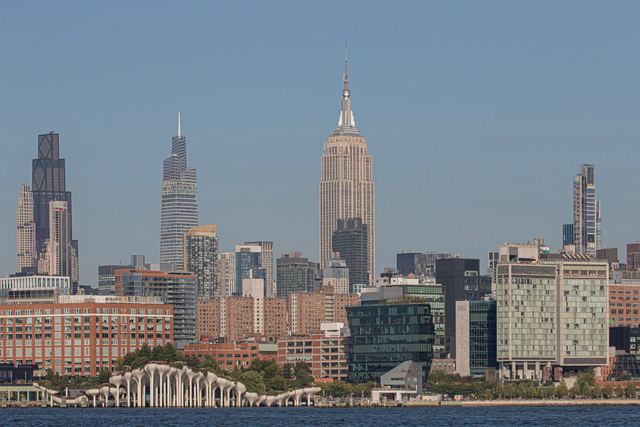
New York real estate is really several markets under one name: New York City, the Long Island and Westchester suburbs that depend on it, and the older upstate cities of Buffalo, Rochester, Syracuse and Albany. A statewide average hides all of this, and the cost of a home can differ by a factor of seven between two places in the same state.
This page is for readers who arrived from a city page and want the state picture first: Census Bureau figures for twenty New York places, then the tax, closing cost, disclosure and risk questions that apply to buyers across the state.
New York cities compared: values, rents and ownership
The table covers the 20 New York places we used to describe on their own pages. Values are medians for owner-occupied homes, rent is the median gross rent (rent plus utilities), and the last column is the share of occupied homes lived in by their owners.
In New York the Census Bureau reports cities, towns and villages, and the label in brackets shows the type when it is not a city. A town can contain several villages, so Hempstead (a town) overlaps with villages such as Freeport and Valley Stream. Do not add those rows together.
| City | Population | Median home value | Median gross rent | Owner-occupied share |
|---|---|---|---|---|
| New York | 8,516,202 | $751,700 | $1,779 | 32.8% |
| Buffalo | 276,397 | $152,300 | $989 | 42.7% |
| Rochester | 209,720 | $120,600 | $1,039 | 37.2% |
| Yonkers | 209,529 | $478,000 | $1,730 | 47.2% |
| Syracuse | 146,211 | $125,100 | $998 | 41.3% |
| Albany | 100,081 | $223,000 | $1,178 | 37.9% |
| New Rochelle | 81,591 | $667,300 | $1,830 | 51.4% |
| Mount Vernon | 72,528 | $449,600 | $1,546 | 42.1% |
| Schenectady | 68,521 | $152,000 | $1,109 | 44.8% |
| Utica | 64,440 | $133,400 | $907 | 50.0% |
| White Plains | 59,818 | $624,100 | $2,151 | 52.4% |
| Hempstead (town) | 789,177 | $618,800 | $2,057 | 82.2% |
| Troy | 51,054 | $192,500 | $1,134 | 36.8% |
| Niagara Falls | 48,198 | $104,400 | $784 | 57.5% |
| Binghamton | 47,357 | $117,400 | $867 | 43.3% |
| Freeport (village) | 44,102 | $479,700 | $1,984 | 70.9% |
| Long Beach | 34,741 | $661,500 | $2,377 | 63.4% |
| Spring Valley (village) | 32,995 | $351,500 | $1,673 | 25.6% |
| Valley Stream (village) | 40,278 | $605,000 | $1,994 | 79.5% |
| Rome | 31,795 | $137,200 | $871 | 55.4% |
Source: US Census Bureau, American Community Survey 2019-2023 5-year estimates (tables B01003, B25077, B25064 and B25003). Each row describes the area named, using the Census Bureau's own boundaries.
Jump to a section
- New York cities compared: values, rents and ownership
- What the table says about New York's markets
- Property tax and STAR relief in New York
- Closing costs, disclosure and the role of agents
- Insurance and risks New York buyers should check
- Three details that rarely appear on the first page of results
- How to use this page
What the table says about New York's markets
New York City ($751,700), New Rochelle ($667,300) and Long Beach ($661,500) have the highest median values, while Niagara Falls ($104,400), Binghamton ($117,400) and Rochester ($120,600) have the lowest. The top is about 7.2 times the bottom. Rents show the same split but more mildly: Long Beach ($2,377), White Plains ($2,151) and Hempstead ($2,057) are the highest, and Niagara Falls ($784), Binghamton ($867) and Rome ($871) the lowest, a gap of about 3 to 1.
Dividing the median value by a year of median rent shows where owning is expensive compared with renting. The figure is 9.7 years in Rochester, 10.4 in Syracuse and 11.1 in Niagara Falls, and it rises to 23.0 in Yonkers, 30.4 in New Rochelle and 35.2 in New York City.
A low number often draws cash-flow investors to upstate cities. A high number means buyers are paying for access to Manhattan, schools and neighborhoods. This is a rough comparison of two different groups of households and ignores taxes, insurance and repairs, so it is not a return calculation.
Ownership shares are the second divide. Hempstead (82.2%), Valley Stream (79.5%) and Freeport (70.9%) are places where most households own, while Spring Valley (25.6%), New York City (32.8%) and Troy (36.8%) are mostly renter places. Rochester (37.2%) and Albany (37.9%) also have far more renters than owners. In renter-heavy places a buyer is often looking at a condominium, a cooperative or a small multifamily building.
Property tax and STAR relief in New York
Property tax in New York is set locally by counties, cities, towns, villages and school districts, so two houses of the same value can have very different bills. The statewide relief program is STAR, which lowers the school tax. For new homeowners the Department of Taxation and Finance says that only the STAR credit is available to them, with an income limit of $500,000, while the older exemption with a $250,000 limit remains for people who already had it.
The enhanced version for owners aged 65 or older has a lower income limit, $110,750 for 2026. Check the current rules on the department's STAR eligibility page and register as soon as you own the house, because the credit does not apply automatically.
Closing costs, disclosure and the role of agents
Transfer tax and the mansion tax
New York State charges a transfer tax of $2 for each $500 of price, paid by the seller. A buyer pays the separate mansion tax of 1% on a residential purchase of $1 million or more. Both are explained on the Department of Taxation and Finance transfer tax page.
The mansion tax applies from $1 million of price, so it matters in New York City, Westchester and parts of Nassau County, where prices are highest. Local transfer taxes and bank and title fees come on top, so ask for a written estimate of the whole closing cost before you commit.
Seller disclosure
Under Real Property Law section 462, a seller of residential real property must complete and sign a property condition disclosure statement and deliver it to the buyer or the buyer's agent before the buyer signs a binding contract of sale. The form warns that a knowingly false or incomplete statement may expose the seller to claims by the buyer, before or after the transfer of title.
The statement describes what the seller knows and does not replace an inspection. If the seller learns something that makes it materially inaccurate, a revised statement must be delivered as soon as practicable. Read it before you sign and ask your attorney about anything that looks missing.
Attorneys and agents
Most New York purchases are made through a licensed agent, and an attorney commonly represents each side in the contract and the closing. That makes the attorney a normal part of the cost and an early adviser on title, co-op or condominium documents and inspections. Hire one before you sign anything binding.
Insurance and risks New York buyers should check
Flooding is the main risk for buyers in coastal Nassau and Suffolk counties, along the Hudson, and in low-lying parts of upstate cities after heavy rain or snowmelt. A standard homeowner policy does not cover flood damage, so check the FEMA flood map for the address and ask for a flood insurance quote before you make an offer.
Older upstate housing may have outdated wiring, lead paint and aging heating systems, and a long winter makes the roof and the furnace costly items. Ask for the age of both and the last five years of claims on the house.
Three details that rarely appear on the first page of results
- New buyers only get the STAR credit: a person who buys a house now cannot take the older school tax exemption, and has to register for the credit. Income limits are $500,000 for the credit and $250,000 for the exemption that earlier owners kept.
- Seller pays the state transfer tax, buyer pays the mansion tax: at $1 million the 1% buyer tax is $10,000, so a price just under the line can change what the buyer owes at closing.
- Disclosure comes before the contract: the statement has to be delivered before the buyer signs a binding contract, so ask for it at the first offer and not at the closing table.
How to use this page
If you came from a city page, find that city's row, compare it with its neighbors in the table, and then apply the tax and closing rules above. Confirm the actual tax bill, the STAR status and the flood zone for the address before you commit.